Pulsar™-18 T3
Peripheral Self-Expanding Nitinol Stent System
Pulsar™-18 T3 Peripheral Self-Expanding Nitinol Stent System is a strut stent mounted on a tri-axial low profile (4F) delivery system. It is indicated for use to improve luminal diameter in patients with symptomatic de novo, restenotic, or occlusive lesions located in the superficial femoral or proximal popliteal arteries, with reference vessel diameters from 3.0 to 6.0 mm and total lesion lengths up to 190 mm.*
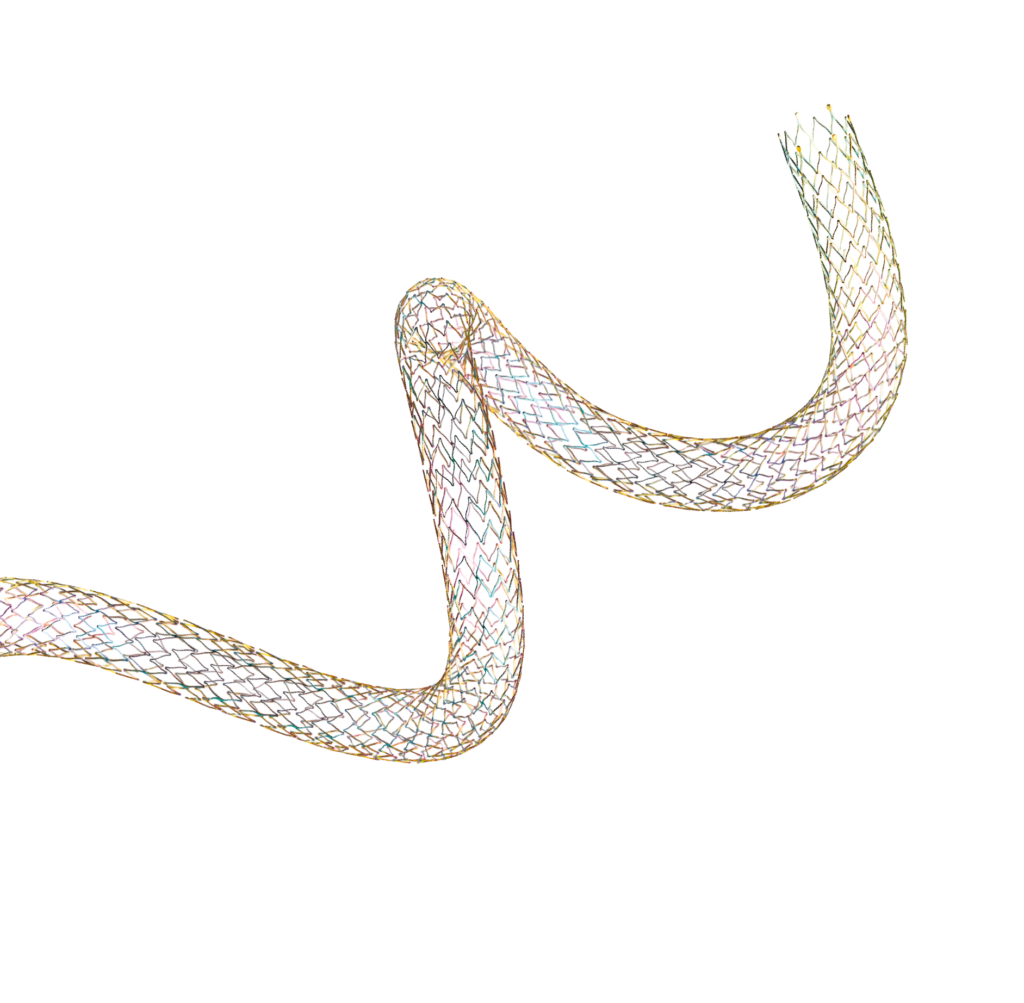
Technical Data
| Stent | |
|---|---|
| Catheter type | OTW |
| Recommended guide wire | 0.018” |
| Stent material | Nitinol |
| Strut thickness | 140 μm |
| Strut width | 85 μm - 90 μm |
| Stent coating | proBIO™ Coating (Amorphous Silicon Carbide) |
| Stent markers | 6 gold markers each end |
| Sizes | 4.0 - 7.0 mm: L:20 - 200 mm |
| Shaft | 4F, hydrophobic coating, tri-axial |
| Usable length | 90 cm and 135 cm |
Ordering Information
| Stent (mm) | Catheter length 90 cm (Stent length mm) | |||||||||||||||||||
|---|---|---|---|---|---|---|---|---|---|---|---|---|---|---|---|---|---|---|---|---|
| 20 | 30 | 40 | 60 | 80 | 100 | 120 | 150 | 170 | 200 | |||||||||||
| 4F | 4.0 | 430437 | 430438 | 430439 | 430440 | 430441 | 430442 | 430443 | 430444 | 430445 | 430446 | |||||||||
| 4F | 5.0 | 430447 | 430448 | 430449 | 430450 | 430451 | 430452 | 430453 | 430454 | 430455 | 430456 | |||||||||
| 4F | 6.0 | 430457 | 430458 | 430459 | 430460 | 430461 | 430462 | 430463 | 430464 | 430465 | 430466 | |||||||||
| 4F | 7.0 | 430467 | 430468 | 430469 | 430470 | 430471 | 430472 | 430473 | 430474 | 430475 | 430476 | |||||||||
| Stent (mm) | Catheter length 135 cm (Stent length mm) | |||||||||||||||||||
|---|---|---|---|---|---|---|---|---|---|---|---|---|---|---|---|---|---|---|---|---|
| 20 | 30 | 40 | 60 | 80 | 100 | 120 | 150 | 170 | 200 | |||||||||||
| 4F | 4.0 | 430477 | 430478 | 430479 | 430480 | 430481 | 430482 | 430483 | 430484 | 430485 | 430486 | |||||||||
| 4F | 5.0 | 430487 | 430488 | 430489 | 430490 | 430491 | 430492 | 430493 | 430494 | 430495 | 430496 | |||||||||
| 4F | 6.0 | 430497 | 430498 | 430499 | 430500 | 430501 | 430502 | 430503 | 430504 | 430505 | 430506 | |||||||||
| 4F | 7.0 | 430507 | 430508 | 430509 | 430510 | 430511 | 430512 | 430513 | 430514 | 430515 | 430516 | |||||||||
*Indications: The Pulsar-18 T3 stent system is indicated for use to improve luminal diameter in patients with symptomatic de novo, restenotic or occlusive lesions located in the superficial femoral or proximal popliteal arteries, with reference vessel diameters from 3.0 to 6.0 mm and total lesion lengths up to 190 mm.
Contraindications:
- Patients with known hypersensitivity to nickel or amorphous silicon carbide.
- Patients with uncorrected bleeding disorders and contraindication to antiplatelet and/or anti-coagulation therapy.
Warnings:
- In patients with poor kidney function, contrast agents may precipitate kidney failure.
- Persons with known hypersensitivities to the following substances may suffer an allergic reaction to this implant:
– Nitinol and / or its components (e.g. nickel, titanium)
– amorphous silicon carbide
- DO NOT use the device after the Use by date indicated on the label.
- Device is supplied STERILE and for single use only. DO NOT re-sterilize and/or reuse. Reuse of single use devices creates potential risks including infections. Contamination of the device may lead to serious injury or patient harm. Cleaning, disinfection, and sterilization may compromise essential material and design characteristics leading to device failure. BIOTRONIK will not be responsible for any direct, incidental or consequential damages resulting from resterilization or reuse.
- This device carries an associated risk of subacute thrombosis, vascular complications and bleeding events. Appropriate anticoagulation and antiplatelet therapy should be administered pre- and post-procedure in accordance with standard practices.
- If using to treat a previously stented lesion, long-term outcomes following repeat dilatation of endothelialized stents have not been studied.
- DO NOT use the stent system if the outer package (including the foil pouch) and/or inner package are/is damaged or opened, or if any information provided is obscured or damaged.
- DO NOT use in patients after failed guide wire or balloon catheter access.
- DO NOT use guide wires with 0.014” (0.36 mm) diameter.
- If unusual resistance is experienced during the introduction of the stent system or deployment, or if stent cannot be deployed, remove the entire stent system (a partially deployed stent may require surgical removal).
- Advancement of the stent system without the guide wire extended beyond the tip may lead to vessel damage.
- DO NOT advance a partially deployed stent proximally or distally. Dragging or repositioning the stent may cause injury to the patient.
- Once the stent is partially deployed it cannot be recaptured using the stent system.
- Limited data exists on use of two overlapping stents. If multiple stents are required to treat a lesion, it is only recommended to use stents of same metal type and a maximum of two stents. The risk of corrosion increases when stents of differing metals contact one another. Overlapping of more than two stents has not been investigated.
- DO NOT use if the device is damaged, the safety button is pressed down (locked), or if the stent is partially deployed.
- Manipulate the stent system under angiographic guidance when it is in the patient’s body.
- If a large amount of thrombus is present in the vessel, the use of alternative or adjunctive strategies (mechanical debulking, thrombolysis, GPIIb/IIIa inhibitors) must be considered.
- The foil pouch within the outer packaging is not a sterile barrier. The inner pouch within the foil pouch is the sterile barrier. Only the contents of the inner pouch are sterile. The outer surface of the inner pouch is not sterile.
- DO NOT use the device in the coronary, cervical and intra-cranial arteries as this is prohibited
Precautions:
- Only physicians thoroughly trained and educated in the performance of PTA and stent implantation should use this device.
- Stenting across a bifurcation or side branch could compromise future diagnostic or therapeutic procedures.
- The minimum introducer sheath size is indicated on the label. If the device is used in conjunction with long and/or braided introducer sheaths, a larger French size than indicated on the label may be necessary to reduce friction.
- Use only guide wires with a 0.018” (0.46 mm) diameter.
- Verify that the distal end of the outer shaft is flush against the tip.
- Exercise care during handling to reduce the possibility of releasing the stent prematurely, accidental breakage, bending or kinking of the catheter shaft.
- Exposure of the stent system to organic solvents, e.g. alcohol, may cause damage to the stent system.
- The stent system is not designed for use with power injection systems.
- Precautions to prevent or reduce clotting should be taken. The use of systemic heparinization during the procedure is recommended.
- Avoid manipulation of the stent release mechanism during removal from packaging and flushing of the stent system.
- If more than one stent is planned to treat a lesion, it is recommended to place the more distal stent first. Allow for sufficient overlap between the stents.
- Recrossing a stent with adjunct devices must be performed with caution.
- The use of mechanical atherectomy devices or laser catheter is not recommended within the stented area.
- Fractures of Nitinol stents implanted in the superficial femoral artery have been reported in medical literature. Fractures occurred more frequently and were more severe in long stented segments and in the case of multiple, partially overlapping stents. These fractures were frequently associated with restenosis or occlusion of the artery.
- Prior to the procedure, the stent system should be visually examined to verify functionality and ensure that its size is suitable for the specific procedure for which it is to be used .
- DO NOT continue to turn the wheel after the stent has been fully deployed to avoid withdrawal difficulties.
- After use dispose the product and packaging in accordance with hospital, administrative and/or local government policy.
Potential Adverse Events/Complications:
Possible complications include, but are not limited to:
- Allergic reactions to contrast media, antiplatelets aggregation or anticoagulant medications, amorphous silicon carbide and Nitinol and/or its components (e.g. nickel, titanium).
- Bleeding events: access site bleeding or hemorrhage and hemorrhage requiring transfusion or other treatment.
- Death.
- Embolization of air, thrombotic or atherosclerotic material.
- Emergency surgery to correct vascular complications.
- Infection and sepsis.
- Nephropathy.
- Stent system events: failure to deliver stent to intended site, stent misplacement, stent deformation, stent embolization, stent thrombosis or occlusion, stent fracture, stent migration, inadequate apposition or compression of stent/s, withdrawal difficulties, embolization of the delivery system material.
- Tissue necrosis and limb loss due to distal embolization.
- Vascular events: access site hematoma, hypotension/ hypertension, pseudoaneurysm, arteriovenous fistula formation, retroperitoneal hematoma, vessel dissection or perforation, restenosis, thrombosis or occlusion, vasospasm, peripheral ischemia, dissection and distal embolization (air, tissue debris and thrombus).
CAUTION: Federal (USA) law restricts this device to sale or use by or on the order of a physician.
Teleflex, the Teleflex logo, Pulsar and proBIO are trademarks or registered trademarks of Teleflex Incorporated or its affiliates in the U.S and/or other countries. All other names are the trademarks or registered trademarks of their respective owners. Refer to this IFU link for a copy of the Instructions for Use and for a complete listing of the indications, contraindications, warnings and precautions. Information in this material is not a substitute for the product Instructions for Use. Not all products may be available in all countries.
© 2026 Teleflex Incorporated. All rights reserved. MC-011816 Rev 0. Revised: 04/2026.