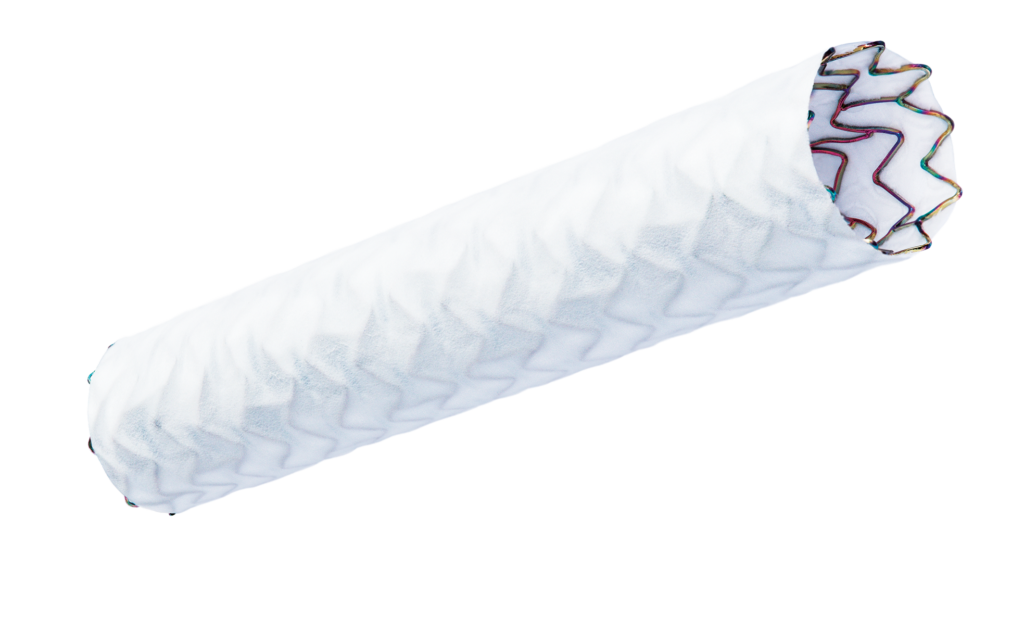
PK Papyrus™ Covered Coronary Stent System*
Indicated for the treatment of acute perforations of native coronary arteries and coronary bypass grafts in vessels 2.5 to 5.0 mm in diameter**
Technical Data
| Stent | ||||||||
|---|---|---|---|---|---|---|---|---|
| Stent cover material | Non-woven, electrospun polyurethane | |||||||
| Stent material | Cobalt chromium (L-605) with proBIO™ Coating (amorphous silicon carbide) | |||||||
| Maximum stent expansion diameter | 2.5 - 3.0 mm: 3.50 mm; 3.5 - 4.0 mm: 4.65 mm; 4.5 - 5.0 mm: 5.63 mm | |||||||
| Delivery system | ||||||||
|---|---|---|---|---|---|---|---|---|
| Guide wire diameter | 0.014” | |||||||
| Usable catheter length | 140 cm | |||||||
| Recommended guide catheter | 2.5 - 4.0 mm: 5F (min. Inner Diameter 0.056”); 4.5 - 5.0 mm: 6F (min. Inner Diameter 0.070”) | |||||||
| Sizes | 2.5 - 5.0 mm; L: 15, 20, and 26 mm | |||||||
| Nominal pressure (NP) | 2.5 - 3.5 mm: 8 atm; 4.0 - 5.0 mm: 7 atm | |||||||
| Rated burst pressure (RBP) | 2.5 - 4.0 mm: 16 atm; 4.5 - 5.0 mm: 14 atm | |||||||
Compliance Chart
| Inflation pressure | Stent inner diameter (mm) | |||||||||||
|---|---|---|---|---|---|---|---|---|---|---|---|---|
| atm | 2.5 | 3.0 | 3.5 | 4.0 | 4.5 | 5.0 | ||||||
| Nominal Pressure (NP) | 7 | - | - | - | 4.01 | 4.55 | 4.93 | |||||
| Nominal Pressure (NP) | 8 | 2.52 | 2.99 | 3.53 | 4.14 | 4.69 | 5.09 | |||||
| 9 | 2.59 | 3.07 | 3.63 | 4.26 | 4.82 | 5.23 | ||||||
| 10 | 2.65 | 3.15 | 3.71 | 4.35 | 4.91 | 5.34 | ||||||
| 11 | 2.70 | 3.21 | 3.77 | 4.43 | 4.99 | 5.43 | ||||||
| 12 | 2.74 | 3.26 | 3.82 | 4.49 | 5.06 | 5.50 | ||||||
| 13 | 2.77 | 3.30 | 3.86 | 4.54 | 5.11 | 5.56 | ||||||
| Rated burst Pressure (RBP) | 14 | 2.80 | 3.34 | 3.90 | 4.59 | 5.16 | 5.61 | |||||
| 15 | 2.83 | 3.37 | 3.93 | 4.63 | - | - | ||||||
| Rated burst Pressure (RBP) | 16 | 2.86 | 3.40 | 3.96 | 4.67 | - | - | |||||
Ordering Information
| Guide Catheter Compatibility | Stent Size (mm) | Stent length (mm) | ||||
|---|---|---|---|---|---|---|
| 15 | 20 | 26 | ||||
| 5F | 2.5 | 434887 | 434893 | - | ||
| 5F | 3.0 | 434888 | 434894 | 434899 | ||
| 5F | 3.5 | 434889 | 434895 | 434900 | ||
| 5F | 4.0 | 434890 | 434896 | 434901 | ||
| 6F | 4.5 | 434891 | 434897 | 434902 | ||
| 6F | 5.0 | 434892 | 434898 | 434903 | ||
*Humanitarian Device. Authorized by Federal law for use in the treatment of acute perforations of native coronary arteries and coronary bypass grafts in vessels 2.5 to 5.0 mm in diameter. The effectiveness of this device for this use has not been demonstrated.
**Indication as per IFU
INDICATIONS FOR USE:
The PK Papyrus Stent System is indicated for the treatment of acute perforations of native coronary arteries and coronary bypass grafts in vessels 2.5 to 5.0 mm in diameter.
CONTRAINDICATIONS:
Contraindications for PK Papyrus Stent System and stenting in general are:
• Patients in whom antiplatelet agents or anticoagulation therapy is contraindicated.
• Patients with a known allergy or hypersensitivity to amorphous silicon carbide or any other compound of the system (siloxane-based polyurethane, L-605 cobalt chromium alloy including tungsten and nickel).
• Lesions that cannot be reached or treated with the system.
• Lesions with threatened or abrupt closure during attempted pre-dilation prior to stent implantation.
• Risk of treatment-related occlusion of vital coronary artery side branches.
• Uncorrected bleeding disorders.
• Allergy to contrast media.
WARNINGS:
• This device is designed and intended for single use only. DO NOT resterilize and/ or reuse. Reuse of single-use devices creates a potential risk of patient or user infections. Contamination of the device may lead to injury, illness or death of the patient. Cleaning, disinfection, and sterilization may compromise essential material and design characteristics leading to device failure.
• DO NOT use the stent system if the outer or the inner package is damaged or opened, or any information provided is obscured or damaged.
• DO NOT use device after the “Use by” date indicated on the label.
• DO NOT rotate the stent system if the tip is constrained.
• DO NOT expose the stent system to organic solvents e.g. alcohol.
• DO NOT apply vacuum prior to introduction of the stent system. This may cause premature dislodgement of the stent.
• Manipulate the stent system under angiographic guidance when it is in the body.
• Use only an appropriate balloon inflation medium (e.g. 50:50 mixture by volume of contrast medium and saline). NEVER use air or any gaseous medium to inflate the balloon.
• To reduce the potential for vessel damage, the inflated diameter of the balloon should not exceed the original diameter of the vessel proximal and distal to the lesion. • Balloon pressure must not exceed the rated burst pressure (RBP). Use of a pressure-monitoring device is mandatory to prevent over-pressurization.
• DO NOT inflate/deflate the delivery system balloon for more than five cycles. • Patients with renal insufficiency receiving a PK Papyrus Stent may be at an increased risk of worsening renal function or renal failure due to the need for an increased volume of contrast.
• Caution should be taken if a PK Papyrus Stent is inserted in thrombus-containing lesions, as this may increase the risk of complications, including myocardial infarction and death.
• Covered stents used to treat coronary ruptures can be associated with high rates of restenosis. Restenosis of a PK Papyrus Stent may require revascularization of the arterial segment. The safety and effectiveness of re-dilation of a PK Papyrus Stent to treat restenosis have not been established
PRECAUTIONS:
• Only physicians thoroughly trained and experienced in the performance of percutaneous transluminal coronary angioplasty (PTCA) and stent implantation should use this device.
• Narrow, calcified and tortuous lesions or other lesions that could impede the delivery of the PK Papyrus Stent must be pre-dilated with an appropriately-sized angioplasty balloon or another arterial dilatation method before using the PK Papyrus Stent System.
• Exercise care during device handling to reduce the possibility of disrupting the placement of the stent on the balloon and accidental breakage, bending or kinking of the stent system shaft and damaging its cover.
• Forceful movements may dislodge the protector and the stent.
•The click-in hypotube fastener is intended to hold only the hypotube section of the delivery system; the distal shaft should not be held by the click-in fastener.
• When removing the stent protector, always pull at the very distal end of the protector to avoid dislodging the stent.
• Prior to the procedure, the stent system should be visually examined to verify functionality; the stent must be visually checked for uniformity, no protruding struts, centering on the balloon, and cover integrity and ensure that its size is suitable for the specific procedure for which it is to be used.
• Avoid excessive manipulation of the stent during flushing of the guide wire lumen.
• Use guiding catheters with a minimum inner diameter of ≥ 0.056” (1.42 mm; 5F) for 2.5-4.0 mm stents and a minimum of ≥ 0.070” (1.78 mm; 6F) for 4.5-5.0 mm stents.
• Use only guide wires with a diameter of 0.014” (0.36 mm).
• When inserting and positioning the stent system, ensure that the hemostatic valve of the guiding catheter is fully open. A partially opened hemostatic valve may damage the stent, the cover integrity or dislodge the stent from the centered location on the balloon.
• Ensure that the guide wire exit port remains inside the guiding catheter at all times. The guide wire exit port is indicated on the label.
• DO NOT apply excessive force while accessing or crossing the lesion. This may damage the stent, stent cover and/or dislodge the stent from the balloon. If resistance is felt at any time, stop the procedure and determine the cause of resistance before proceeding. If the stent system is unable to reach or cross the lesion easily, the procedure should be aborted. Refer to the section “Removal of an Unexpanded Stent.”
• DO NOT inflate the balloon if a vacuum cannot be held as this indicates a leak in the delivery system. If a vacuum cannot be held, refer to section “Removal of an Unexpanded Stent.”
• Inflate to at least the nominal pressure (NP) indicated on the label and in the “Compliance Chart” table. DO NOT exceed the rated burst pressure (RBP).
• Avoid barotrauma outside the stent margins during post-dilation.
• DO NOT post-dilate the stent to more than the maximum expandable diameter recommended in the “Sizes” table.
• The use of mechanical atherectomy or laser catheters is not recommended in the stented area.
• Exercise care during crossing the deployed stent with guide wires, accessory devices, or adjunct devices to avoid disruption of the stent cover, disruption of the stent geometry, or stent migration.
• If resistance is encountered during removal of the delivery system, remove the delivery system and the guiding catheter as a single unit. Refer to section “Removal of the Delivery System/Stent System and the Guiding Catheter as a Single Unit.”
• DO NOT re-insert the stent system as the stent and/or the delivery system may have been damaged during the initial attempt to cross the lesion or during withdrawal.
• Failure to follow correct removal steps for an unexpanded stent system and/or applying excessive force to the stent system can potentially result in loss or damage to the stent and/or delivery system components.
ADVERSE EVENTS:
Possible adverse events associated with the use of the PK Papyrus Stent System when used as intended are:
• Cardiac events: myocardial infarction or ischemia; abrupt closure of treated artery or side branch; restenosis of the treated artery; cardiogenic shock; angina; coronary dissection; perforation or other coronary or aortic injury; residual coronary perforation; cardiac perforation; pericardial effusion; pericardial tamponade; coronary aneurysm formation; need for emergency cardiac surgery.
• Arrhythmic events: ventricular tachycardia, ventricular fibrillation, atrial fibrillation, sinus bradycardia.
• Stent system events: failure to deliver the stent to the intended site, stent dislodgement from the delivery system, stent deformation, stent embolization, stent thrombosis or occlusion, stent fracture, stent migration, stent loss, mal-apposition of the stent to the arterial wall, delivery system balloon inflation or deflation difficulties, delivery system balloon rupture, delivery system withdrawal difficulties, embolization of catheter material.
• Respiratory events: acute pulmonary edema, congestive heart failure, respiratory insufficiency or failure.
• Vascular events: pseudoaneurysm; arteriovenous fistula; retroperitoneal hemorrhage or hematoma; vessel dissection, perforation, rupture or other injury; restenosis, thrombosis or occlusion; compromise of side branch patency; occlusion of side branches; vasospasm; peripheral ischemia; embolization of air, thrombotic, atherosclerotic or catheter material.
• Hemodynamic events: hypotension or hypertension.
• Neurologic events: stroke, TIA, peripheral nerve injury.
• Bleeding events: access site hemorrhage, access site hematoma.
• Local or systemic infection.
• Allergic reactions to contrast media, antiplatelet agents, anticoagulants, amorphous silicon carbide or any other system components (e.g., siloxane-based polyurethane, L-605 cobalt chromium alloy including tungsten and nickel).
• Death.
CAUTION: Federal (USA) law restricts this device to sale or use by or on the order of a physician.
Teleflex, the Teleflex logo, PK Papyrus and proBIO are trademarks or registered trademarks of Teleflex Incorporated or its affiliates in the U.S and/or other countries. Refer to this IFU link for a copy of the Instructions for Use and for a complete listing of the indications, contraindications, warnings and precautions. Information in this material is not a substitute for the product Instructions for Use. Not all products may be available in all countries.
© 2026 Teleflex Incorporated. All rights reserved. MC-011821 Rev 0. Revised: 05/2026